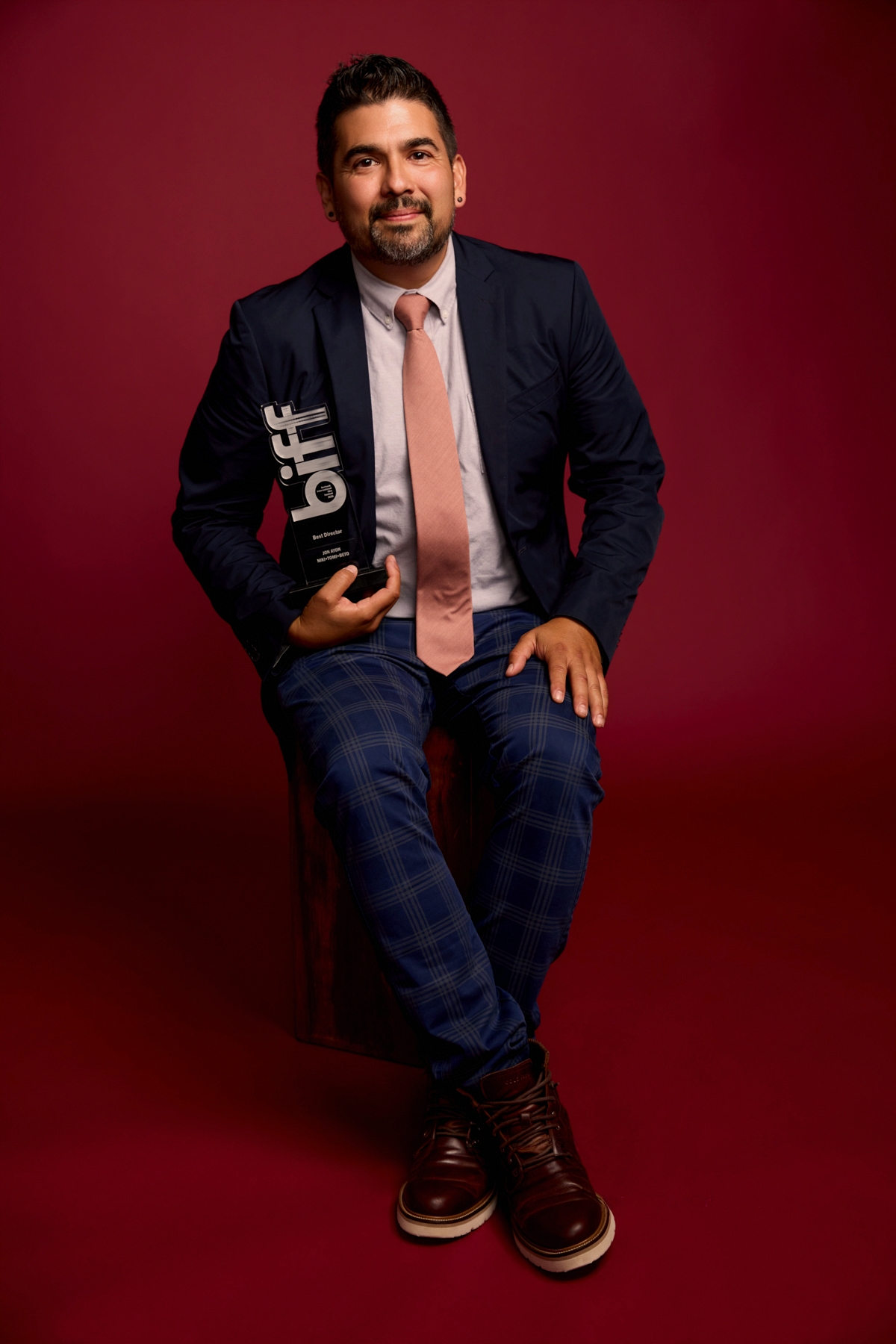
JON AYON is a writer and director from Oakland, CA, by way of Northeast LA, where he was born and raised. Ayon is a native Spanish speaker and currently an assistant professor of film and digital media at UC Santa Cruz. He earned his BA in cinema production from San Francisco State University and his MFA in documentary film and video production from Stanford.
As a Mestizo (Comcáac/Nahua-Salvadoreño/Xicano) son of Mexican and Salvadoran immigrants, Ayon grew up with a massive family split not only by political borders but also by cultural ones—Indigenous, Spanish, and African. Because of this, Ayon’s work often focuses on the hybridizations and ruptures of ancestral and modern cultures that shape the urban Mestizo family representing a large percentage of immigrant households in North America.
Ayon’s documentary films have won awards like the Grand Prize in ’18 Coppola Director’s Short Competition, ’20 Best Documentary Short from NewFilmmakers LA, and ’22 Full Frame President’s Award, among others. His work has also been nominated for awards from IDA, Screencraft, Nantucket Film Festival, and Slamdance. In ’22, he was awarded the North Star fellowship at Camden International Film Festival and a Filmhouse residency at SFFILM.
His latest short, NIKI•TOMI•BETO, is in national festival circulation and recently won Best Director at the 2026 Burbank International Film Festival. He was recently selected as a 2027 California Arts Council Emerging Artist Fellow, ’26-’27 Hellman Fellow, ’26 Manchester-Stowe Story Labs Fellow, and ’26 Bendfilm: Basecamp Fellow for his feature, IN DREAMS, I AM A VALLEY (currently in development).
Jon Ayon is proudly devoted to telling immigrant stories in an anti-immigrant world.
Nominations
2026 | Lola Awards Nominee—Los Shorts, Philadelphia Latino Arts & Film Festival
2026 | Short Film Lab Finalist, Roadmap Writers
2023 | ScreenCraft Short Script Finalist
2023 | Sundance Doc Edit Lab Finalist
2022 | David Wolpner Award Nominee, International Documentary Association
Awards, Fellowships, & Grants
2027 | California Arts Council Emerging Artist Fellow
2026 | Bendfilm: Basecamp Fellow
2026 | Best Director, Burbank International Film Festival
2026 | Audience Award Best Short, SF Indie Fest
2026 | Hellman Fellowship
2026 | UK Development Lab Fellow, Stowe Story Labs x Manchester Film Festival
2024 | Narrative Grant, The Berkeley Film Foundation
2022 | Best Short Film, Highland Park Indie Film Festival
2022 | Best International Documentary, Puerto Rico Film Festival
2022 | North Star Fellowship, Points North Institute
2022 | President’s Award, Full Frame Doc Festival
2022 | SFFILM Filmhouse Residency
2021 | Best Documentary, NewFilmmakers LA
2020 | Virginia Dares Cinematic Arts Award for Decolonizing/Re-Indigenizing Media
2020 | Best Short Documentary, NewFilmmakers LA
2020 | The Charla Fund US Latinx Art Forum
2019 | Diversity & Inclusion Writing Fellowship, Lower Boom Studios
2018 | Grand Prize, Francis Ford Coppola Short Film Competition
2018 | Production Grant, Caucus for Producers, Writers, & Directors + Annenberg Foundation
Contact
Filmmaker’s disclaimer on the use of the word Mestizo/e:
Like Mulatto, the term Mestizo comes from colonial efforts to segregate and can be seen or heard as a dirty word meaning biracial or mixed-race. In the 20th century, there was a neoliberal effort by Latin American countries to reinvent the use of the word Mestizo as part of a multiculturalist campaign to erase individual Indigeneity. This was done to whitewash the history of state-sponsored genocide of Indigenous communities throughout Latin-America. This multiculturalism was an attempt to hammer the final nail in the coffin of Indigenous erasure through assimilation and migration, and it was called “el mestizaje.” When I first began reclaiming the term Mestizo, I employed it as a means to explain my brown skin and complexion to whites and non-Latines. I soon realized that this reason was influenced by a colonial perception (or misconception) of myself and my identity. In 2008, I began investigating—through family interviews, research, and traveling to meet tribal relations—my own heritage and ancestry. Since then, my use of the word Mestizo—and now, Mestizx or Mestize—evolved to include a parenthetical (Comcáac/Nahua-Salvadoreño/Xicano). This honors each of the tribes and nationalities that make up my heritage and connects myself and my work to my grandparents and great-grandparents without claiming tribal affiliation. This inherited dislocation is often summed up by the term “detribalized Mestizo.” In the U.S., the terms Indigenous/American Indian/Native American are political identities. Similarly, the terms “Mestizo” and “Afro-mestizo” in Mexico are recognized as member nations by the National Indigenous Congress of Mexico (CNI) which was founded by the EZLN. Meaning, to the CNI, Mestizo is also considered a political identity. My use of the terms Mestizo or Mestizx or Mestize is not only an effort to reestablish kinship and alliances with Indigenous nations across Latin America, but also a method of finding space without taking space.
Somos ni de aquí, ni de allá pero aun tenemos raíces.

